A Month-by-Month Procurement Guide to Hokkaido's Finest Seafood
Hokkaido sits at the confluence of two powerful ocean current systems—the cold Oyashio current flowing south from the Arctic and the warmer Tsushima current pushing north from the Pacific—and this collision creates one of the most productive marine environments on earth. The waters surrounding the island are extraordinarily nutrient-rich, supporting populations of scallops, sea urchin, king crab, salmon, and dozens of other species at densities that few other fisheries can match. But productivity is not uniform across the calendar. Each species follows its own biological schedule, and the difference between purchasing at peak season versus off-peak can be the difference between a transcendent meal and a mediocre one.
For American buyers sourcing Hokkaido seafood—whether through specialty online retailers, Japanese grocery importers, or direct-from-Japan channels—understanding this seasonal architecture is not optional knowledge. It is the foundation of intelligent purchasing.
January and February: The King Crab and Snow Crab Window
Midwinter is crab season in Hokkaido, and it is the most celebrated period in the island's seafood calendar. Zuwaigani (snow crab) and kegani (horsehair crab) reach peak sweetness during the coldest months, when frigid water temperatures slow their metabolism and concentrate sugars in the flesh. The commercial fishing season for snow crab in Hokkaido's Sea of Okhotsk region typically runs from November through March, with January and February representing the height of quality.
For American buyers, this means that frozen snow crab products processed during this window—available through premium importers—carry the best flavor profile of the year. When reviewing product descriptions or speaking with suppliers, ask specifically about the processing date and whether the product was frozen at sea or land-processed. At-sea freezing, which occurs within hours of catch, consistently outperforms land-processing in preserving the delicate sweetness that defines Hokkaido crab.
Storage guidance: Properly vacuum-sealed frozen Hokkaido snow crab maintains peak quality for up to six months when stored at 0°F or below. Thaw overnight in the refrigerator rather than under running water; slow thawing minimizes moisture loss and preserves texture.
March and April: Scallop Pre-Season and Kelp Harvest
Hokkaido hotate scallops are harvested year-round, but the late winter and early spring period is particularly significant because it precedes the primary growth surge that peaks in summer. March and April scallops from Hokkaido's Sarufutsu and Okhotsk regions tend to be slightly smaller than their summer counterparts but are prized by Japanese chefs for their cleaner, more mineral-forward flavor—a direct reflection of the cold, nutrient-dense water they have fed through all winter.
This is also the primary harvest window for high-grade kombu kelp, which is collected from Hokkaido's southern coastline as winter storms subside. Rishiri and Rausu kombu, the two most prestigious varieties, are harvested from specific geographic zones and dried through spring and early summer. Kombu purchased from importers in late spring and early summer has often been processed from this window's harvest and carries optimal glutamate concentration.
May and June: The Salmon Trout and Early Uni Season
Hokkaido's sakuramas (cherry salmon or masu trout) run in rivers and coastal waters from April through June, peaking in May. This species is less well-known internationally than Pacific salmon but is deeply embedded in Hokkaido's culinary identity. Its flesh is rich and finely textured, with a fat content that makes it exceptional for both raw preparations and gentle curing. American buyers can occasionally find sakuramas through specialty Japanese seafood importers during this window, though availability is limited by quota restrictions and export volumes.
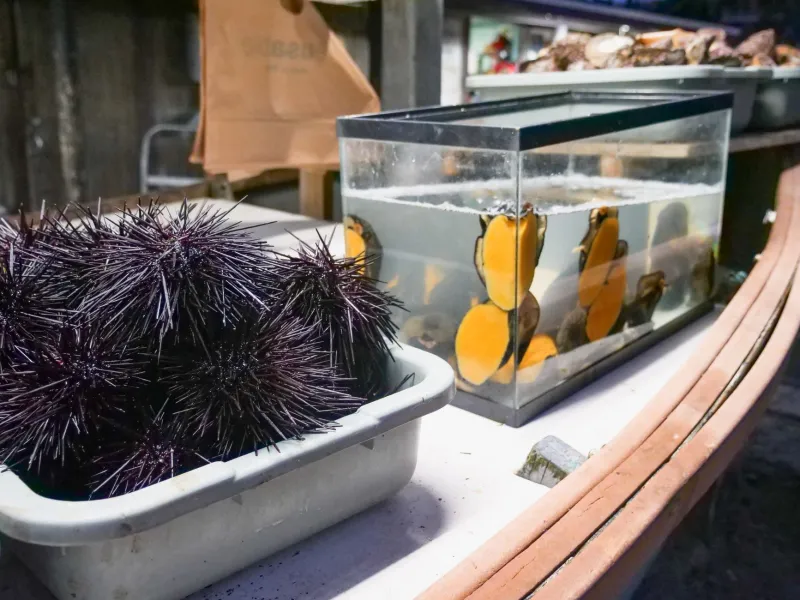
More accessible is the early season for Hokkaido bafun uni (short-spined sea urchin), which begins producing harvestable roe in late May in certain northern zones. Bafun uni is smaller than the more visually familiar kita murasaki uni but consistently delivers more intense sweetness and a longer finish. The early-season product tends toward a slightly firmer texture than midsummer uni, which some chefs prefer for plated preparations where the roe needs to hold its form.
July and August: Peak Uni and Hotate Season
This is arguably the most important two-month window in the Hokkaido seafood calendar for American buyers. Both sea urchin species—bafun and kita murasaki—reach their annual peak in terms of roe volume and flavor intensity during midsummer, driven by the plankton bloom that follows spring warming. Hokkaido uni harvested in July and August and processed into premium tray-packed product represents the best the fishery produces.
Hotate scallops also achieve their largest size and highest adductor muscle glycogen content during this period, translating directly to the pronounced natural sweetness that distinguishes Hokkaido scallops from Pacific or Atlantic alternatives. For American buyers planning to stock a freezer with premium scallops, targeting importers who process and freeze product from this window is the single most impactful purchasing decision you can make.
A note on uni freshness: Because sea urchin roe is extremely perishable, most Hokkaido uni reaching American consumers arrives frozen rather than fresh. Premium frozen uni processed with minimal additives during peak season is, counterintuitively, often superior to fresh uni that has spent days in transit. When evaluating products, look for uni processed without alum (a preservative that imparts bitterness) and frozen within hours of harvest.
September and October: Salmon Season and Ikura
Autumn is salmon season, and in Hokkaido it means both the fish itself and its roe—ikura—which is one of the most sought-after ingredients in Japanese cuisine. Hokkaido's salmon populations, dominated by chum and pink salmon, return to their natal rivers from late August through October. The roe harvested during this run is processed immediately into shoyu-zuke ikura (soy-marinated salmon roe), which has a finite peak quality window of roughly three months when properly refrigerated.
American buyers who want to experience genuinely premium ikura should target importers who receive fall-run Hokkaido product between September and November. Ikura produced from fish caught earlier in the season, before the eggs fully develop, lacks the characteristic pop and richness that defines the best product. Similarly, ikura from the very late run can have overly firm roe membranes. The mid-October sweet spot is worth seeking out.
November and December: Hairy Crab and Pre-Winter Scallops
As water temperatures drop and summer species recede, kegani (horsehair crab) comes into its own. This species—small, intensely flavored, and nearly impossible to find outside Japan—is at its best in late autumn when the crab has been feeding intensively through summer and early fall. The internal crab miso (tomalley) is particularly prized during this period for its richness and complexity.
November and December also see a secondary scallop quality peak as water temperatures cool and the animals' metabolisms shift. This pre-winter product is leaner than the summer peak but has a cleaner, sharper flavor that many chefs prefer for raw preparations such as crudo or carpaccio.
Building a Year-Round Sourcing Strategy
The most effective approach to sourcing Hokkaido seafood is not reactive but planned. By mapping anticipated purchases to the seasonal calendar outlined above, American buyers can align their orders with genuine quality peaks rather than defaulting to whatever happens to be available at a given moment. Specialty importers who work directly with Hokkaido producers—rather than purchasing through intermediaries—are far more likely to be able to confirm processing dates and seasonal sourcing details.
The seasonal rhythm of Hokkaido's waters is not a limitation. It is an invitation to engage with food in a more deliberate, informed way—one that rewards patience and preparation with ingredients that perform at their absolute best.